Jonathan Trzop:
In May 2022, I was officially diagnosed with retinitis pigmentosa at 19 years old. By the time doctors confirmed it, I had about 8 percent vision in each eye, roughly 10 percent combined. I remember walking out of that appointment feeling like my entire future had been flipped upside down.
That morning, I drove myself to college like I always had. I went from driving, training, and planning my career to suddenly needing rides and rethinking everything.
In middle school and high school, I was always bumping into things, missing obstacles, running into wet floor signs. I just thought I was clumsy or not paying attention. Doctors noticed black spots on my retina as early as 2015, but referrals moved slowly.
By the time I finally had a proper visual field test, the damage was already significant.
The strange thing about retinitis pigmentosa is that what you can’t see doesn’t look blurry, it’s just gone. You don’t realize what’s missing until it starts affecting your life in bigger ways.
Hockey has been part of my life for as long as I can remember. I started skating around six or seven years old and played minor hockey through my early teens. When I was 12, I started officiating a path inspired by my uncle, who spent decades refereeing major junior hockey, international tournaments, and even the 2010 Vancouver Olympics.
After my diagnosis, I thought hockey was over with playing or referring.
That summer I tried playing with a local ball hockey league. I was introduced to Simon Richard, an assistant captain with Canada’s national blind hockey team. We met for a coffee at Tim Hortons before work. He told me about Blind Hockey and invited me to come try a camp.
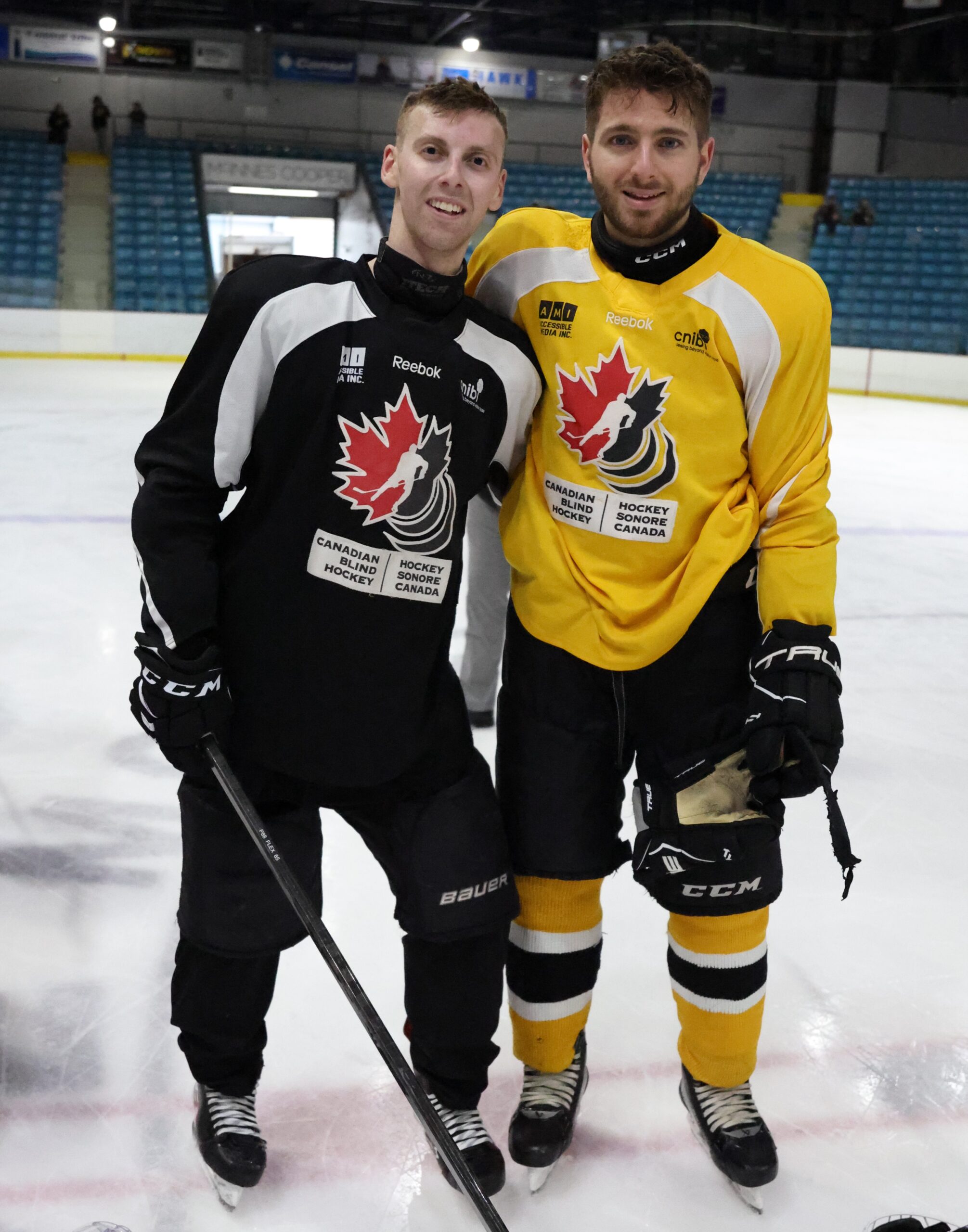
By late fall, I was back on the ice—this time discovering blind hockey for the first time. In March 2023, I competed in the Open Division at the Canadian National Blind Hockey Tournament.I fell in love with the game immediately.
I focused heavily on my skating. Without full vision, edge work, balance, and tight turns matter more than ever. Years of officiating had already helped develop my skating, and blind hockey pushed it even further.
By Nationals in 2023, I knew this was something I wanted to pursue seriously. It’s been incredible to be a member on the Canadian National Blind Hockey Tournament. Simon is now my biggest inspiration in Blind Hockey that I look up to. He continues to make sure that I stay positive and that I keep working.
Today, my life is busy. I balance school, full-time work, hockey, and participation in a clinical trial aimed at slowing, or stopping – the progression of my vision loss. Every three months, I travel for long days of testing which includes visual field exams, dark adaptation tests, dilations.
If everything continues to go well, I may undergo surgery designed to halt further vision loss in one eye. Nothing is guaranteed, but even the possibility is something I’m grateful for.
This season, Blind Hockey came to Moncton and it was amazing. Family, former teammates, and fellow officials got to see the game for the first time.
It was incredible to see the feature on Sportsnet. If sharing my story helps even one person believe there’s still a path forward on or off the ice then it’s worth telling.
Simon Richard:
I was born with Aniridia, which means I have no iris which is the coloured ring-shaped muscle at the front of the eye that controls the size of the pupil. This makes me legally blind with blurred vision and sensitive to light.
At 5 years old my friends were starting to play traditional hockey so I also wanted to start playing. It was very hard to play at first as I had a hard time seeing the puck and following the play. As my dad realized my struggles he found a way to teach me the concepts of the game. I can still picture in my head my dad sitting at the kitchen table with me and his coaching board explaining the positioning of each player on the ice and the concepts and strategies of the game. He had a game that he called “Where is the puck?”, where he placed some x’s and o’s on his board and I had to identify where the puck was.
This is how I started to understand the patterns of the game and how I started to develop my hockey IQ and start improving on the ice. I still play traditional hockey to this day with friends multiple times a week and it helps with my training for Blind Hockey events as the game is fast and it keeps me sharp.
I immersed myself in Para sport when I started playing goalball at the age of 9 years old. As I started to develop in that sport and realized that I had some potential I started to dream about competing at the Paralympic Games at 12 years old. I just missed out on my original goal of making the team for the 2012 London Paralympic Games (at 18), but it just gave me more fuel to keep pushing myself harder to be the best athlete I could be. When I was selected for the 2016 Rio Paralympic Games it was literally a dream that came true. It was and always is a true honour to wear that maple leaf on your jersey. We really feel that the whole nation is behind us. I cherished every moment at the Games.
I have really enjoyed my time playing goalball, but I have decided to give myself another challenge by playing Blind Hockey and help where I can to grow the sport. I have now been on the Canadian National Blind Hockey Team for eight years. The goal is to grow the sport enough to compete at the Winter Paralympic Games and establish a professional Blind Hockey League. In my professional career I am also program manager at Parasport New Brunswick. We are trying to grow all the Paralympic sports in the province so that more kids and adults get to play and have a positive experience in Para sports.
Having the Eastern Regional Blind Hockey Tournament hosted in my hometown of Moncton has truly been a remarkable honor. Being able to play alongside my local teammate and member of the Canadian National Blind Hockey Team Jonathan Trzop is a lot of fun. The connection to Hockey Day in Canada made it extra special to be able to showcase our passion for hockey and highlight the incredible potential within our Blind Hockey community. It was incredibly humbling to represent Moncton and the entire Blind Hockey community during the Hockey Day in Canada festivities by taking part in the Hockey Day Celebrity Game and joining the Sportsnet panel. I really hope this awareness leads us to finding new Blind Hockey players across New Brunswick and beyond.
Richard says Paralympics are ultimate goal for Blind Hockey: Sportnet
Sportsnet feature on Moncton – Growing the sport of Blind Hockey: Youtube