Lorne Webber, Canadian National Blind Hockey Team Goaltender “Losing your vision doesn’t mean giving up the things you love. Sometimes it simply means finding a new way to experience them.”
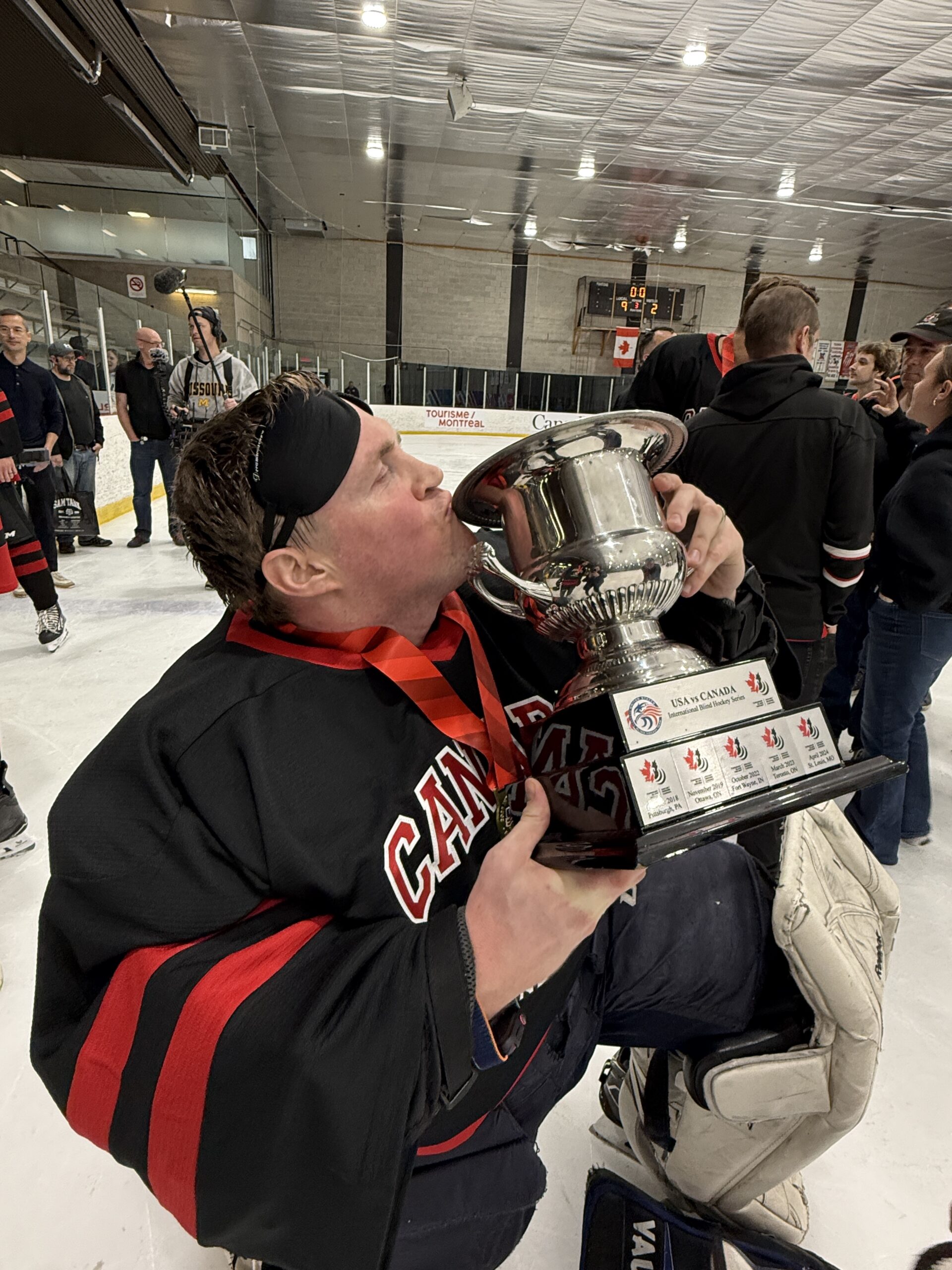
I was born with some vision, but by the age of two my parents knew something wasn’t right. I was wearing thick glasses as a toddler, you know those big thick ones with the strap, and by the time I was five I had contact lenses.
Growing up in the small town of Wembley, Alberta, hockey was everything. My family couldn’t afford organized hockey, so every day after school I’d head to the local rink to play shinny. Those afternoons on the ice were the highlight of my childhood.
When I was around ten years old, everything changed.
I began experiencing retinal detachments. Straight lines became wavy, stairs became difficult to navigate, and over the next several years I underwent 19 eye surgeries in an effort to save my sight. My vision stabilized for a while, but by the age of 16 I had completely lost it.
Like many young people experiencing vision loss, I assumed hockey was over.
Thankfully, my teachers, family and medical team prepared me before that day came. I learned Braille which I’m so grateful for, I started using assistive technology, and was introduced to adaptive sports. At the time I wasn’t thrilled about learning those skills, but today I’m incredibly grateful they encouraged me. Because I had time to adapt gradually, I was better prepared to navigate life when I eventually lost my remaining vision.
After graduating high school, I moved to Edmonton to study Computer Science and Psychology. Today I work as an Assistive Technology Specialist at NorQuest College, helping students with disabilities become more independent by using adaptive technology like screen readers, Braille displays and specialized software.
It’s rewarding work because I get to teach people the same tools that have given me so much independence in my own life.
When I think about losing my vision at a young age, it wasn’t easy. I’ve always believed it’s important to take the time to grieve difficult life changes. But eventually, life moves forward. For me, the key has always been finding ways to make the best of whatever situation I’m in and helping others do the same.
Staying active has been a huge part of that journey.
Before finding Blind Hockey, I competed in goalball, track and field, judo, rock climbing and even dragon boat racing. In 2014, our visually impaired dragon boat team travelled to Ravenna, Italy, where we won a gold medal as the fastest blind dragon boat team in the world.
In 2013, Alberta Blind Sports and Recreation Association organized a Blind Hockey Try-It Day.
The moment I stepped back onto the ice, I fell in love with hockey all over again.
At first, I tried playing as a skater, but as a B1 player someone suggested I try goaltending. It didn’t take long before I realized I’d found my place.
I attended my first Canadian National Blind Hockey Tournament in 2015 and have never looked back. When the Canadian National Blind Hockey Team was formed in 2018, I was honoured to earn a spot.
Being a goalie has given me purpose. It motivates me to stay active, keep improving and challenge myself every day. Making the national team isn’t the finish line. At this level, there’s always something to learn, and every season is another opportunity to become a better athlete and teammate.
That lesson became especially clear in 2024 when I wasn’t selected to the national team.
It was disappointing, but it also reminded me that the margins are incredibly small at the highest level. Rather than becoming discouraged, I used it as motivation to work harder. Sometimes setbacks become the greatest opportunities for growth.
I’ve also been fortunate to learn from amazing coaches, volunteers and teammates throughout my journey. I still remember meeting Joey Ali at my very first national tournament. The time he spent teaching me the fundamentals of goaltending completely changed my game. People like Joey, and so many others across the Blind Hockey community, have helped shape the player I am today.
Seeing new youth programs launch across Canada and watching the sport expand internationally is inspiring. I think back to how I felt when I believed I had to give up hockey forever, and it means everything to know that today’s kids don’t have to feel that way. They can continue playing the game they love alongside teammates who understand their journey.
I also look forward to returning to the Canadian Blind Hockey Summer Camp each year. It’s one of my favourite events because it offers concentrated skill development while giving us time to reconnect with teammates from across the country. Unlike tournaments, where everyone flies in, plays and heads home, camp gives us the chance to build lasting friendships both on and off the ice.
This year will be especially exciting because it will be my first time attending camp at CNIB Lake Joe. I’m looking forward to all of the outdoor activities, especially the chance to try water skiing again something I thought I had lost when my vision disappeared.
If there’s one thing I’ve learned through this journey, it’s that losing your vision doesn’t mean giving up the things you love. Sometimes it simply means finding a new way to experience them.